
Home
Resources
Metrics Library
Customer Acquisition Cost
ACCRA: Conversion
REACT: Convert phase
CAC
Customer Acquisition Cost (CAC)
Customer Acquisition Cost (CAC) is the total marketing and advertising spend required to acquire one new paying customer over a defined period. It is calculated by dividing marketing spend by the number of new paying customers acquired in the same period. CAC tells marketing teams how much each customer cost to win through the channels and campaigns they control.
Signal Type
Efficiency
Metric Role
KPI
Metric Type
Industry Metric
Last Updated
May 2026
09
Frequently asked questions

What is Customer Acquisition Cost (CAC)?
Customer Acquisition Cost (CAC) is the total marketing and advertising spend required to acquire one new paying customer over a defined period. It is calculated by dividing marketing spend by the number of new paying customers acquired in the same period. CAC tells marketing teams how much each customer cost to win through the channels they control.
What is the difference between CAC and CPA?
CPA (Cost per Acquisition or Cost per Action) measures the cost of any specified user action: a signup, a trial start, a lead form, a download. CAC measures specifically the cost of acquiring a paying customer. CPA is broader and campaign-specific. CAC is narrower, business-wide, and tied to revenue. Every CAC is a CPA for the action "became a paying customer," but most CPAs are not CACs.
What is the difference between marketing CAC and fully-loaded CAC?
Marketing CAC counts only the spend marketing teams control directly: paid media, content, creative, agency fees, tools, and events. Fully-loaded CAC adds the salaries, commissions, and allocated overhead behind the marketing operation. Marketing teams typically work with marketing CAC because it covers the costs they can act on. Finance, founders, and investors use fully-loaded CAC when assessing unit economics, the LTV:CAC ratio, and overall business viability. Both are correct; they answer different questions for different audiences.
What is a good CAC?
CAC has no absolute benchmark. It must be evaluated against Customer Lifetime Value (CLV). The widely accepted target is an LTV:CAC ratio of 3:1, meaning customers generate at least three times their acquisition cost over their lifecycle. Below 1:1 the business is losing money on every customer. Above 5:1 the business is likely underinvesting in growth.
What is a goodWhat is CAC payback period? CAC?
CAC payback period is the number of months a customer must remain active before the revenue they generate equals their acquisition cost. The widely-used benchmark is 12 to 18 months for SaaS. Sub-12-month payback funds compounding growth without external capital. 24+ months requires patient capital. Payback period is the cashflow-honest companion to the LTV:CAC ratio.
Sources and methodology. CAC formula and definition derive from standard unit economics literature, including the work of David Skok (Matrix Partners) on SaaS economics, the CFI Customer Acquisition Cost guide, the Wall Street Prep SaaS CAC framework, and the NetSuite ERP CAC reference. Industry benchmarks for 2025 to 2026 aggregated from publicly available SaaS metrics reports and DTC ecommerce industry analyses. Harmonised CPCo computation methodology isREACTIQ360 proprietary.
02
How it is derived from channel data
Unlike Impressions or CTR, CAC is not natively reported by any single advertising platform. It must be composedacross multiple data sources, which is one of the most common sources of CAC mismeasurement. The buildpath:
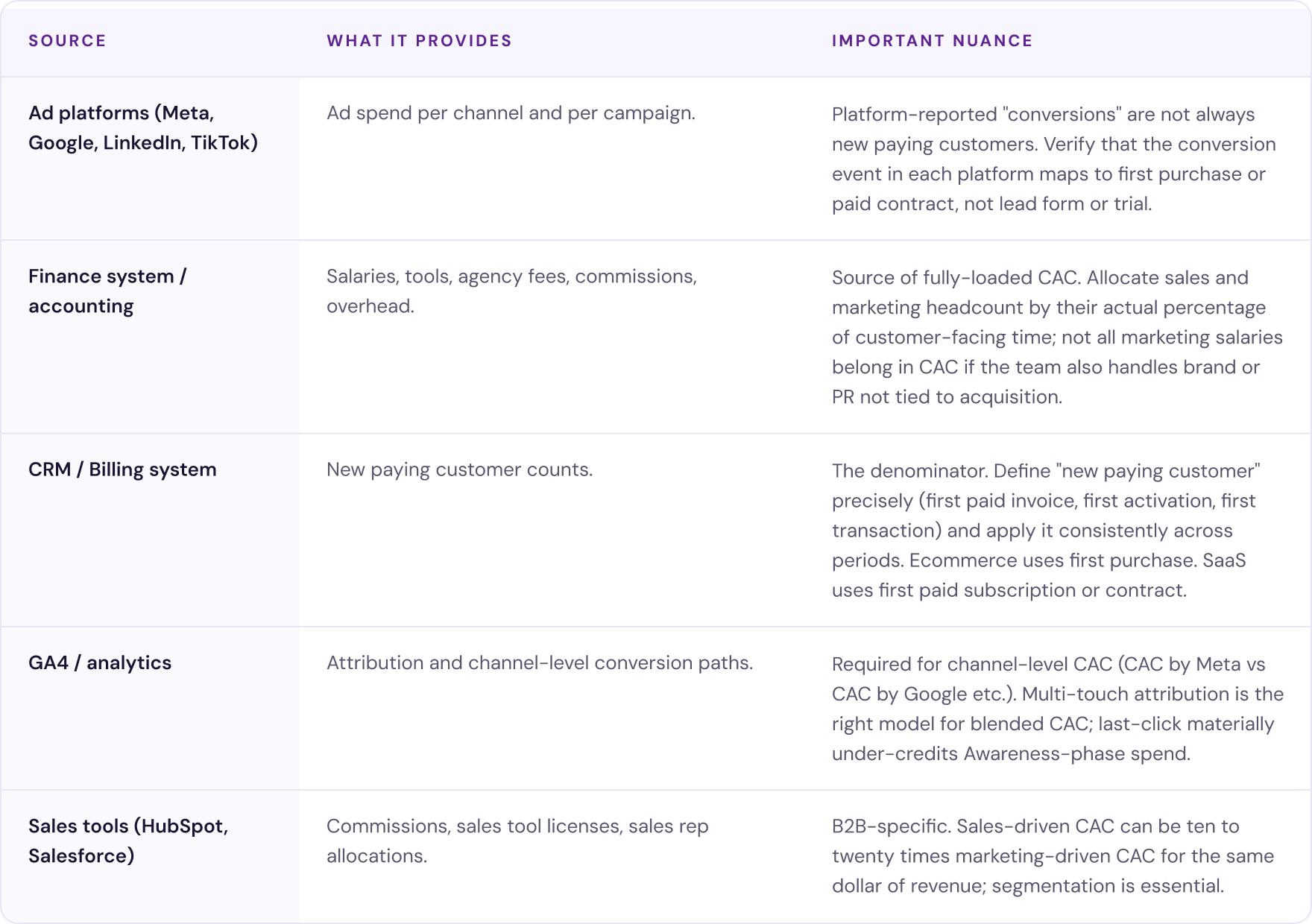
REACTIQ360 harmonises CAC by computing blended sales and marketing spend from connected platforms against new paying customer counts from the CRM and billing layer, with channel-level breakdowns available for diagnostic analysis.
08
Related metrics
CAC sits in a cluster of unit-economic metrics. None of them work alone:
Reach
Volume
IMP
Impressions
The raw material of awareness. Counts every time your content or ad was served, whether an…
⤢
Reach
Volume
IMP
Impressions
The raw material of awareness. Counts every time your content or ad was served, whether an…
⤢
Reach
Volume
IMP
Impressions
The raw material of awareness. Counts every time your content or ad was served, whether an…
⤢
Reach
Volume
IMP
Impressions
The raw material of awareness. Counts every time your content or ad was served, whether an…
⤢
Reach
Volume
IMP
Impressions
The raw material of awareness. Counts every time your content or ad was served, whether an…
⤢
Reach
Volume
IMP
Impressions
The raw material of awareness. Counts every time your content or ad was served, whether an…
⤢
Reach
Volume
IMP
Impressions
The raw material of awareness. Counts every time your content or ad was served, whether an…
⤢
Reach
Volume
IMP
Impressions
The raw material of awareness. Counts every time your content or ad was served, whether an…
⤢
03
When to use it
CAC is the right metric in these decision contexts:
Assessing unit economics. Paired with CLV, CAC determines whether the business can scale profitably. The
LTV:CAC ratio is the single most important sustainability signal in B2B SaaS, ecommerce, and subscription
businesses.
LTV:CAC ratio is the single most important sustainability signal in B2B SaaS, ecommerce, and subscription
businesses.
Allocating marketing budget across channels. Channel-level CAC reveals which acquisition sources are
efficient (and at what scale). Use it to shift spend toward channels with the strongest CAC-to-CLV ratio.
efficient (and at what scale). Use it to shift spend toward channels with the strongest CAC-to-CLV ratio.
Forecasting capital requirements. CAC x target new-customer count gives you the acquisition budget
required to hit growth targets. Critical input for runway planning and fundraising.
required to hit growth targets. Critical input for runway planning and fundraising.
Evaluating sales productivity. Comparing CAC across sales segments (self-serve vs SDR-led vs enterprise)
surfaces which motions are most cost-efficient for each customer profile.
surfaces which motions are most cost-efficient for each customer profile.
Benchmarking against industry. Industry-specific CAC benchmarks (B2B SaaS, ecommerce, consumer
apps) provide context for whether your acquisition economics are competitive or need attention.
apps) provide context for whether your acquisition economics are competitive or need attention.
07
In the REACT framework
CAC lives squarely in the Convert phase of the REACT Framework. It is the cost-efficiency signal of theConversion ACCRA goal, the financial expression of how much energy was spent to transition a user fromConsideration into a paying customer.
Within REACTIQ360, CAC connects to two related metrics. CPCo (Cost per Conversion) is the standard industry signal at the conversion stage, used to compare channels and campaigns. Harmonised CPCo is REACTIQ360's proprietary version: the cross-channel unified figure that blends all acquisition spend across every channel into one CPCo number, eliminating the "which channel claimed credit" attribution wars. Goal-aware ROAS uses CACas a critical input: Conversion-goal ROAS calculations compare revenue against CAC, while Awareness, Consideration, Retention, and Advocacy goals use proxy revenue models.
Most importantly, CAC is half of the CLV:CAC ratio, the survival ratio that determines whether all five ACCRAgoals are working together or against each other. If Retention (CLV) doesn't keep pace with Conversion (CAC),the whole Momentum Loop slows.
Read the REACT Framework for the full architecture of how each metric transfers energy through the Momentum Loop.
04
When not to use it
CAC is one of the most misreported metrics in marketing. The most common errors:
Do not confuse CAC with CPA. CPA measures the cost of any action (signup, trial, lead). CAC measures the cost of acquiring a paying customer. Reporting CPA as CAC overstates acquisition efficiency by 5 to 20 timesdepending on trial-to-paid conversion. This is the most common mistake.
Do not report the wrong CAC to the wrong audience. Marketing CAC answers "is our spend efficient?" Fully-loaded CAC answers "is our business model viable?" Reporting marketing CAC to investors inflates the LTV:CAC ratio and creates uncomfortable conversations later. Reporting fully-loaded CAC to a channel performance review surfaces costs your team cannot act on. Use the right one for the audience.
Do not blend CAC across radically different acquisition motions. A blended CAC that mixes self-serve trial conversion with enterprise sales-led acquisition is meaningless. Segment by motion before reporting.
Do not include existing-customer expansion spend in CAC. Upsell and cross-sell investment is a different unit economic: it improves CLV and Expansion MRR. Including it inflates CAC and obscures the cost of new acquisition.
Do not interpret CAC in isolation. Falling CAC at the same time as falling CLV signals quality erosion, not efficiency improvement. Always read CAC against CLV, retention, and payback period.
Do not freeze CAC measurement at one window. Quarterly CAC smooths out one-off campaign effects;monthly CAC reveals trends. Use both, never just one.
06
Benchmarks and interpretation
CAC has no absolute "good" number. It is only interpretable against CLV (the LTV:CAC ratio) and against industry-specific benchmarks. Typical fully-loaded ranges:
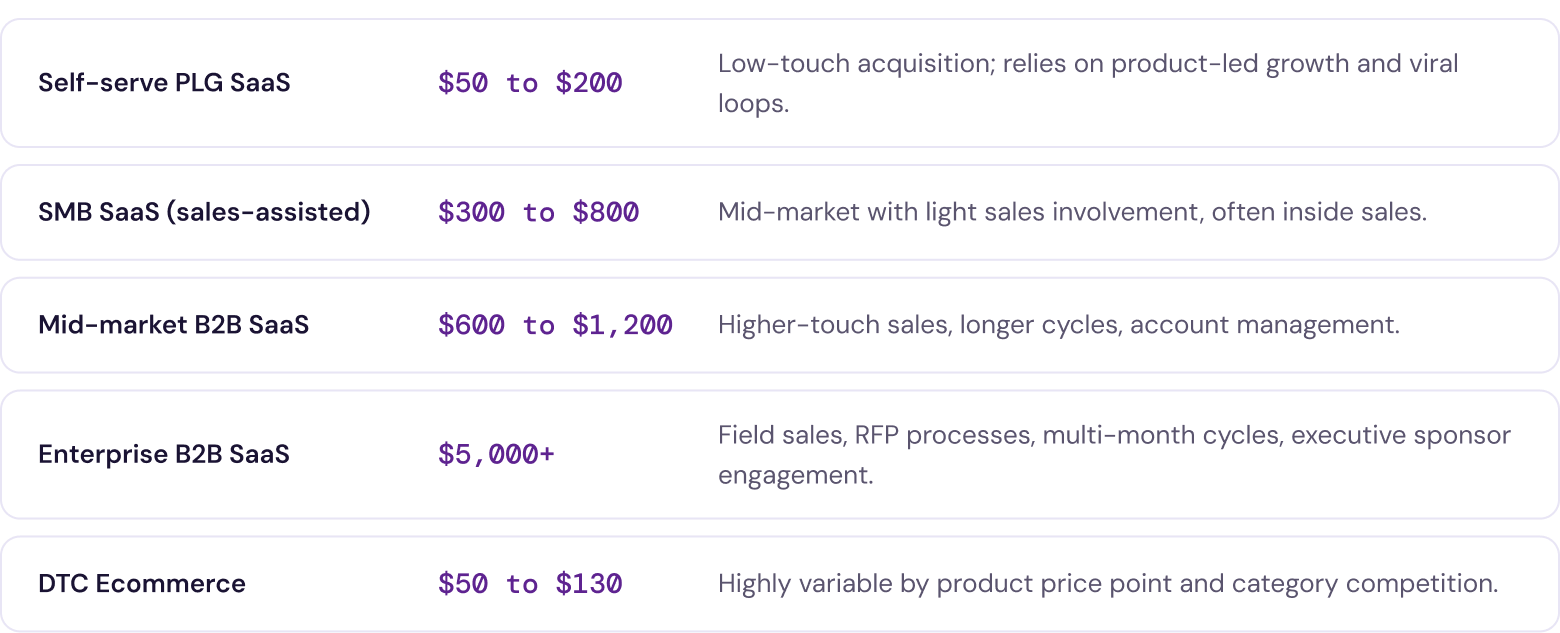
The LTV:CAC ratio (the survival ratio)
The widely-accepted target is LTV:CAC of 3:1 or higher. The implications of different ratios:
Below 1:1. The business loses money on every customer. Cannot scale.
1:1 to 3:1. Marginal or unsustainable. Acceptable only briefly during product or pricing transitions.
3:1. Industry-standard target. Sustainable acquisition economics with reasonable margin.
3:1 to 5:1. Healthy and scalable. Most well-run SaaS sits here.
Above 5:1. Likely underinvesting in growth. The business could acquire more profitably by spending more.
CAC payback period
The cashflow-honest companion to LTV:CAC. SaaS benchmark is 12 to 18 months. Sub-12-month payback fundscompounding growth without external capital. Above 24 months requires patient capital and is risky in volatileinterest-rate environments.
05
Worked example
A B2B SaaS company calculates CAC for Q2. The marketing team reports the marketing CAC; finance reports the fully-loaded CAC for board reporting. Both are derived from the same period, the same customer count, and the same source-of-truth data.
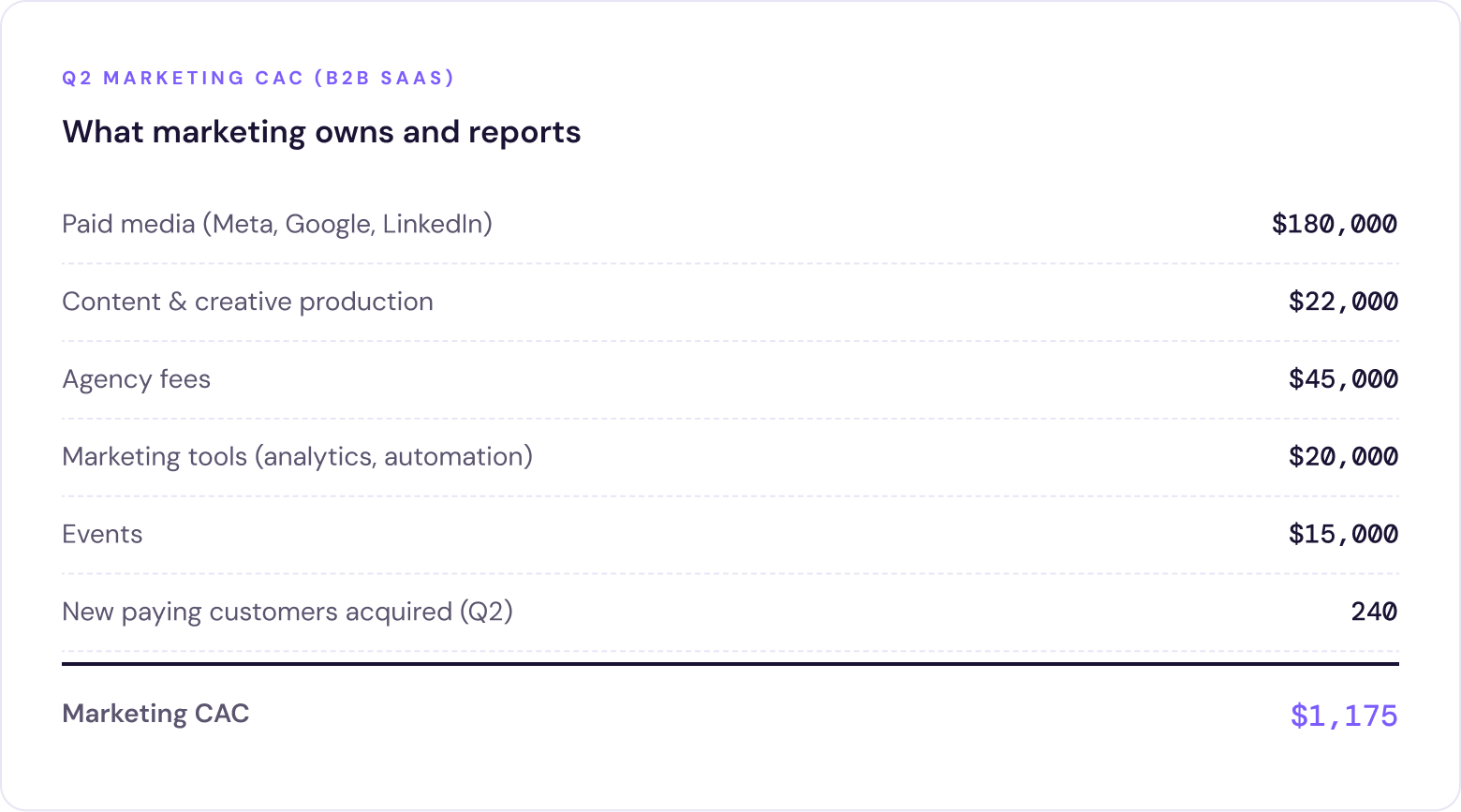
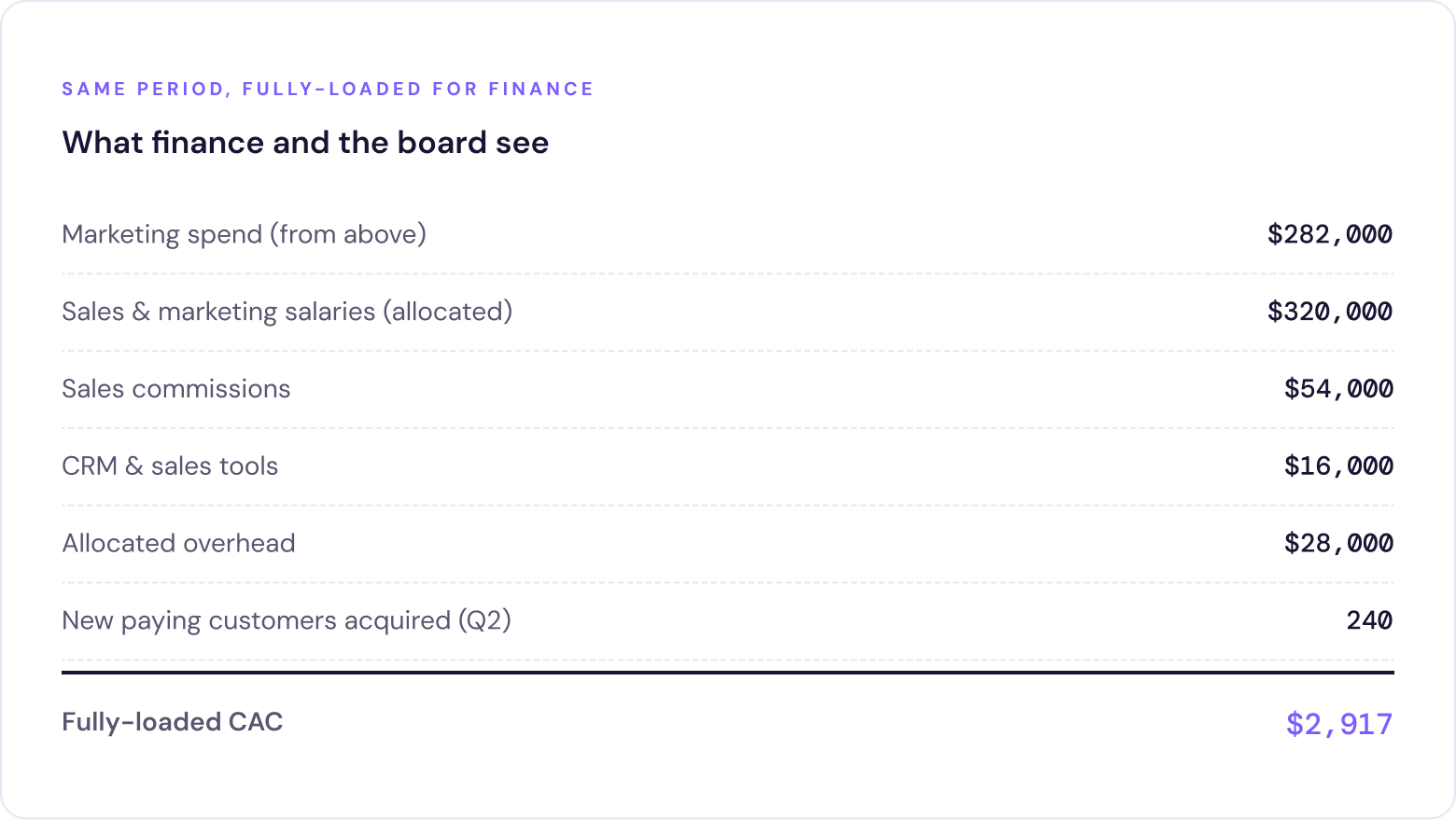
Same business, same period, same customers. Marketing reports $1,175 because that is the spend marketingteams can act on quarter to quarter. Finance reports $2,917 because that is the figure investors and the boardneed to assess unit economics. Both are correct. The team that reports the wrong figure to the wrong audienceis the one in trouble.
On this page
The formula
How it is derived
When to use it
When not to use it
Worked example
Benchmarks & LTV:CAC
In the REACT framework
Related metrics
FAQ
One screen.
One story. One move.
One story. One move.
REACTIQ360 harmonises CAC and 129 other digital marketing metrics into one decision-ready intelligence layer. Powered by proprietary metrics and agentic AI. Beta access is invite-only.
Join the beta waiting list


