Cost per Lead
Cost per Lead (CPL)
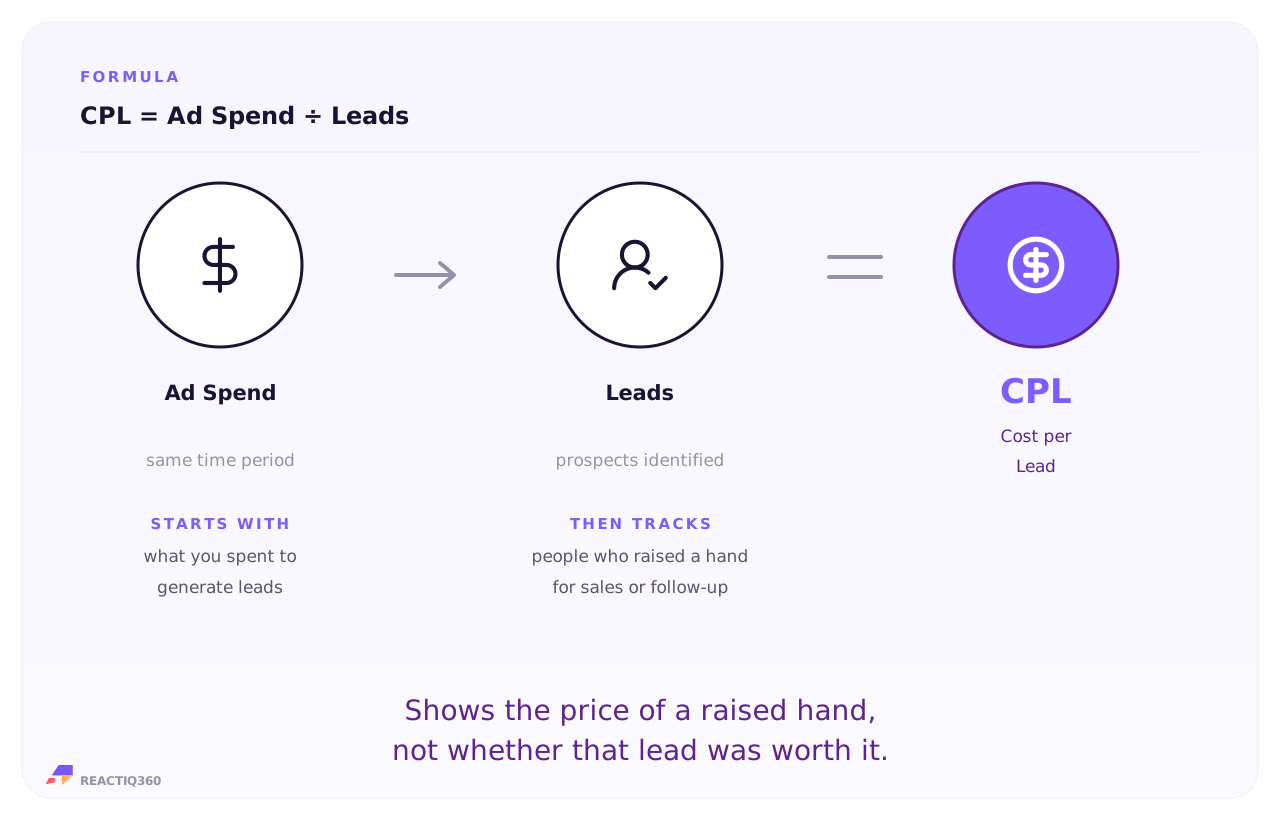
Cost per Lead, or CPL, measures how much spend it takes to identify one prospect.
Divide ad spend by leads. That is CPL. CPL keeps your team honest about early pipeline growth efficiency. While branding campaigns focus on broad impressions and views, CPL calculates the exact price tag to get a prospect to explicitly raise their hand and share their contact details with you. It strips away top of funnel fluff by focusing on verified contact creation, whether that means a newsletter signup, a gated content download, or a webinar registration. It serves as a powerful navigation tool for your growth team, giving you the clear, shared accountability needed to pick the right channels and confidently fuel the sales engine
Signal Type
Metric Role
Metric Type
Last Updated
The Formula
Worked example

Isolate your spend to evaluate your hook.

Here is a growth team auditing an early stage content download campaign. They aggregate their exact ad outlays across channels, cross reference that spend with the raw count of unique, verified contacts added to their CRM database, and isolate the true cost per lead.

CPL Calculator Section
Campaign Media Costs
Meta Direct Lead Ads $12,500
Google Search Keywords $8,000
LinkedIn Lead Forms $4,500

Total Media Spend $25,000
Verified Unique Leads 2,000
$12.50
CPL
$25,000 ÷ 2,000 unique leads
Align your metrics tightly. Measuring your true campaign outlays against the specific contact creation records in that same timeline keeps your early pipeline analysis realistic.
Benchmarks and interpretation

CPL tells you what it costs to capture a prospective customer, i.e. a lead. But a "good" number depends entirely on the value you are unlocking. Pulling in a casual subscriber for a weekend newsletter is a low-stakes trade. Securing a direct line to an enterprise decision-maker who holds a massive budget is a high-value relationship. Your CPL only makes sense when you weigh what you spent against the actual depth and revenue potential of that contact.

Industry Type Typical CPL Lead Capture Context
DTC E-commerce $1 – $5 Basic contact capture via exit intent popups or coupon entries. Relies on quick automation deals.
B2B SaaS / Tech $25 – $75 Content hooks or whitepaper forms. Quality relies on company size and department filtering.
Professional Services $40 – $110 Detailed form fills asking for business project scopes or corporate audit requests.
Finance / Insurance $50 – $150+ Highly competitive search queries requiring partial quote entries or verified agent callback permissions.
The CPL down-funnel velocity check
Evaluating your CPL requires tracking your lead-to-opportunity conversion rate. A channel that delivers thousands of dirt cheap email leads looks brilliant on marketing updates but actively burns resource budget if zero percent of those profiles match your actual buyer criteria. Always verify your early stage lead costs alongside mid funnel opportunity generation so that large volumes of cheap contacts do not mask pipeline stagnation.
Where the number actually comes from

You won’t find a flawless CPL sitting inside a single dashboard. True CPL requires merging your exact media spend from your ad channels with the clean, raw contact creation volumes captured directly inside your CRM or marketing automation tools. If you trust automated network tracking without cross-checking internal lead deduplication files, duplicate counts will distort your marketing math.

Here is exactly where each piece of the puzzle lives and what you need to look out for:

CPL Data Sources Table
Source What it provides Important nuance
Ad platforms Meta, Google, LinkedIn The campaign media spend (the numerator). Isolate your spend strictly to lead generation campaigns. Blending top of funnel brand budgets with direct response lead ads will result in an artificially high and inaccurate CPL calculation.
CRM & Database HubSpot, Salesforce The verified count of new unique contacts (the denominator). This is your pipeline source of truth. Deduplicate the lead records by email address before running your calculation to ensure spam hits, double entries, or bots do not throw off your math.
Analytics software GA4, Tag Manager Form interaction milestones and channel tracking. Web analytics tracking should verify page completion actions. Tracking standard page views instead of successful thank you page redirects will overstate your contact counts.
When to use it

CPL is the right metric in these decision contexts:

CPL Bullet List
  • Budgeting for lead generation drives. Multiplying your target contact volume by your historical CPL gives you the exact spend required to fuel your upfront marketing funnel.
  • Evaluating channel lead quality. Comparing channel-specific CPL helps you see where contact info is cheapest. Use it to balance your media spend against down-funnel sales.
  • Testing campaign hooks and offers. Running CPL across separate whitepapers or resources shows what your market responds to. Scrap assets that deliver expensive leads.
  • Setting automated network targets. Inputting a target CPL into ad platform bidding systems keeps background optimization routines focused on real data collection goals.
  • Predicting sales pipeline growth. Pairing your average CPL with historical lead-to-close win rates lets you accurately project final business revenue growth blocks.
Common Mistakes

CPL is a marketing metric that is often misreported. Common CPL errors to avoid: 

CPL Mistakes List
  • Treating raw form fills as qualified marketing leads. Counting spam submissions, test profiles, or fake phone numbers in your baseline calculation skews your actual pipeline health.
  • Confusing CPL with your total customer acquisition cost. A lead is just an early stage contact milestone. Reporting a low CPL to stakeholders instead of true CAC masks severe funnel conversion drops.
  • Blending loose consumer signups with high intent enterprise requests. Mixing low friction blog subscriptions with detailed sales demo forms creates an arbitrary average that hides true costs.
  • Optimizing for cheap lead volume over quality. Lowering your CPL by removing crucial qualifying questions from your web forms usually swamps your sales pipeline with low value accounts.
  • Relying entirely on network lead form pixel counts. Ad network native lead tools frequently track duplicate clicks or unverified panel profiles. Cross reference always with database files.

In the REACT framework

CPL sits in the Convert phase, most used and most abused in B2B. It measures cost, not value. The goal was never cheap leads. It was affordable customers, and those are different games.

Frequently Asked Questions
What is Cost per Lead?
Cost per Lead, or CPL, measures how much spend it takes to identify one prospect. It prices the hand-raise, and only quality decides whether the price was fair.
How do you calculate Cost per Lead?
Use the formula: CPL = Ad Spend ÷ Total Prospects Identified. Keep both inputs in the same reporting period and avoid mixing users, sessions, events, or customers unless the formula calls for it.
What data do you need for CPL?
You need ad spend and leads, pulled from the relevant connected sources and computed for the same period.
What mistakes should you avoid with CPL?
The classic failure: halving CPL while quality collapses, a worse result wearing a better number. Also avoid comparing CPLs across different lead definitions or form thresholds.
When should marketers use CPL?
Use CPL when managing lead generation spend, always with a quality signal beside it. The decision it feeds is which sources earn more budget, and volume alone cannot answer that.
What is a good CPL?
Good CPL depends on what a lead is worth downstream. Work backwards from deal size and lead-to-customer rate to a ceiling, then judge sources against it.

Sources and methodology. CPL formula and definition derive from standard marketing analytics practice and platform reporting conventions. REACTIQ360 harmonises source data from Ad platforms and marketing spend, CRM / ecommerce / billing, Harmonisation layer and applies a consistent same-period computation methodology.

One screen.
One story. One move.
REACTIQ360 harmonises CAC and 129 other digital marketing metrics into one decision-ready intelligence layer. Powered by proprietary metrics and agentic AI. Beta access is invite-only.
Join the beta waiting list